Quiz - Basic Electrical Laws and Safety
Understanding Basic Electrical Laws
Learning about basic electrical laws is crucial for anyone interested in physics or electrical engineering. These laws form the foundation of how electrical circuits operate.
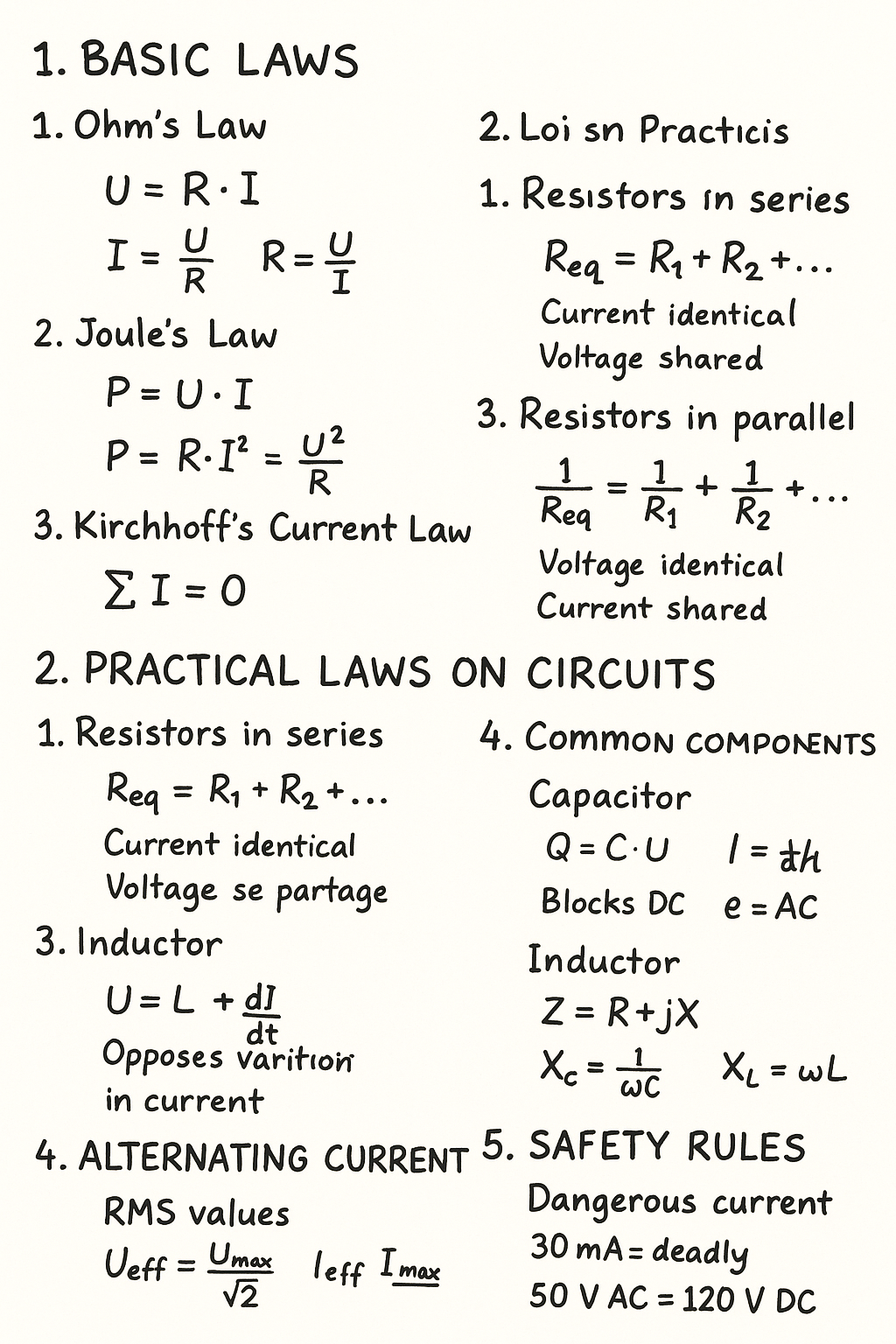
- Ohm's Law helps in understanding the relationship between voltage, current, and resistance, which is essential for designing and analyzing circuits. - Joule's Law provides insight into how electrical energy is converted into heat, which is important for managing energy efficiency and safety. - Kirchhoff's Laws are fundamental for analyzing complex circuits, ensuring that current and voltage are properly distributed.
Practical Applications
- Knowing how resistors work in series and parallel configurations allows for precise control over circuit behavior. - Understanding inductors and capacitors is key to managing alternating current and filtering signals.
Safety Awareness
- Familiarity with safety rules is vital to prevent accidents and ensure safe handling of electrical components.
Relevance
- These concepts are not only academically important but also have practical applications in everyday technology, from household appliances to advanced electronic devices.
By mastering these topics, you gain a comprehensive understanding of how electrical systems function, which is invaluable in both professional and personal contexts.
You may be interested in these quizzes
Basic Electrical Laws and Safety
Fundamental Concepts of Physics
Sound Concepts and Phenomena

Physics Problem: Sphere Radius Calculation

Radioactivity: Invisible and Ionizing

Physics: Trajectory and Velocity

Thermal Equilibrium and Heat Transfer