
Quiz - The Light Spectrum Explained
Question 6 / 8
What is the relationship between wavelength and frequency?
You may be interested in these quizzes
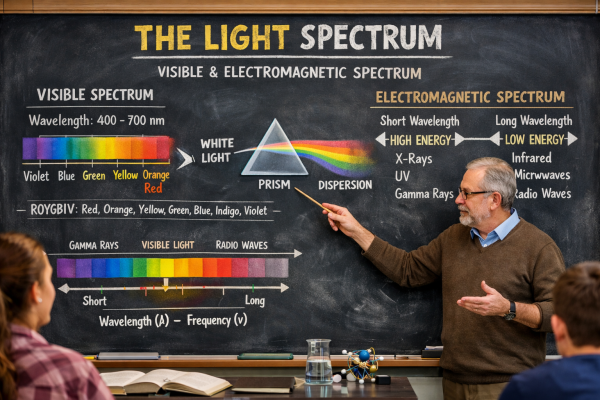
The Light Spectrum Explained
Physics
Optics
Electromagnetism
24/12/2025
The document explains the light spectrum, including visible and electromagnetic spectrums, wavelengths, and energy levels. It covers the dispersion of white light through a prism and the range of electromagnetic waves from gamma rays to radio waves.
Number of questions : 8
Cathode Rays and Discharge Tubes
Physics
History of Science
Electromagnetism
23/08/2026
The document discusses the discovery and properties of cathode rays, including experiments with discharge tubes and the behavior of these rays under different conditions.
Number of questions : 8
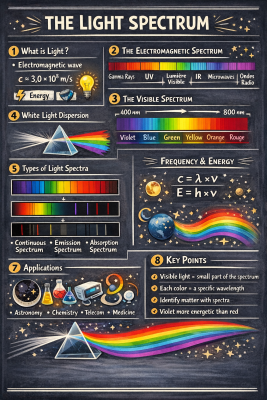
Understanding the Light Spectrum
Physics
Optics
Science
10/02/2026
This infographic explains the light spectrum, covering electromagnetic waves, visible light, light dispersion, types of spectra, and their applications in various fields like astronomy and medicine.
Number of questions : 8
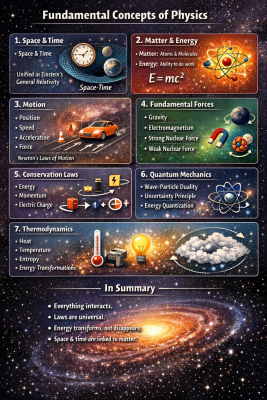
Fundamental Concepts of Physics
Physics
Science
Education
01/03/2026
This infographic outlines the fundamental concepts of physics, including space-time, matter and energy, motion, fundamental forces, conservation laws, quantum mechanics, and thermodynamics. It summarizes key principles such as the interaction of everything, universal laws, energy transformation, and the link between space, time, and matter.
Number of questions : 8
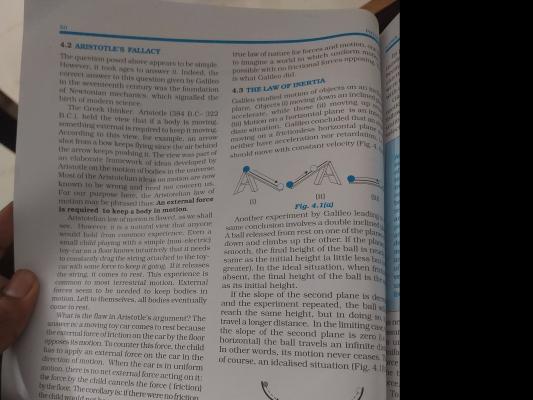
Aristotle's Fallacy and Inertia
Physics
History of Science
Mechanics
31/08/2026
This document discusses Aristotle's fallacy regarding motion and the development of the law of inertia by Galileo. It explains how external forces like friction affect motion and how Galileo's experiments led to a better understanding of uniform motion.
Number of questions : 8
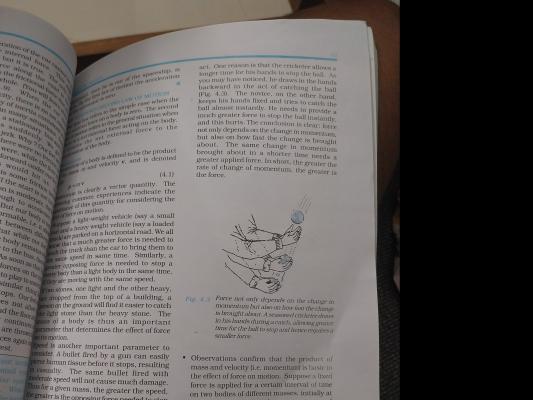
Newton's Second Law Explained
Physics
Mechanics
Newton's Laws
31/08/2026
This document explains Newton's Second Law of Motion, focusing on the relationship between force, mass, and acceleration. It discusses the concept of momentum and how it affects the force needed to stop a moving object. Examples include catching a cricket ball and the effects of mass and speed.
Number of questions : 8
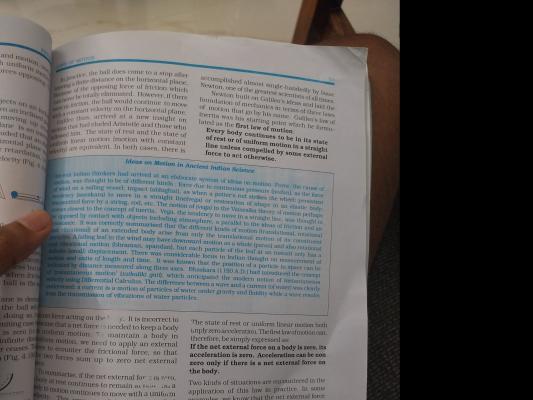
Evolution of Motion Concepts
Physics
History of Science
Classical Mechanics
31/08/2026
This document discusses the evolution of motion concepts from ancient Indian science to Newton's first law of motion. It highlights the contributions of Galileo and Newton in understanding motion, inertia, and the necessity of external forces to change an object's state of motion.
Number of questions : 8