
Quiz - Understanding the Light Spectrum
Number of questions :
8
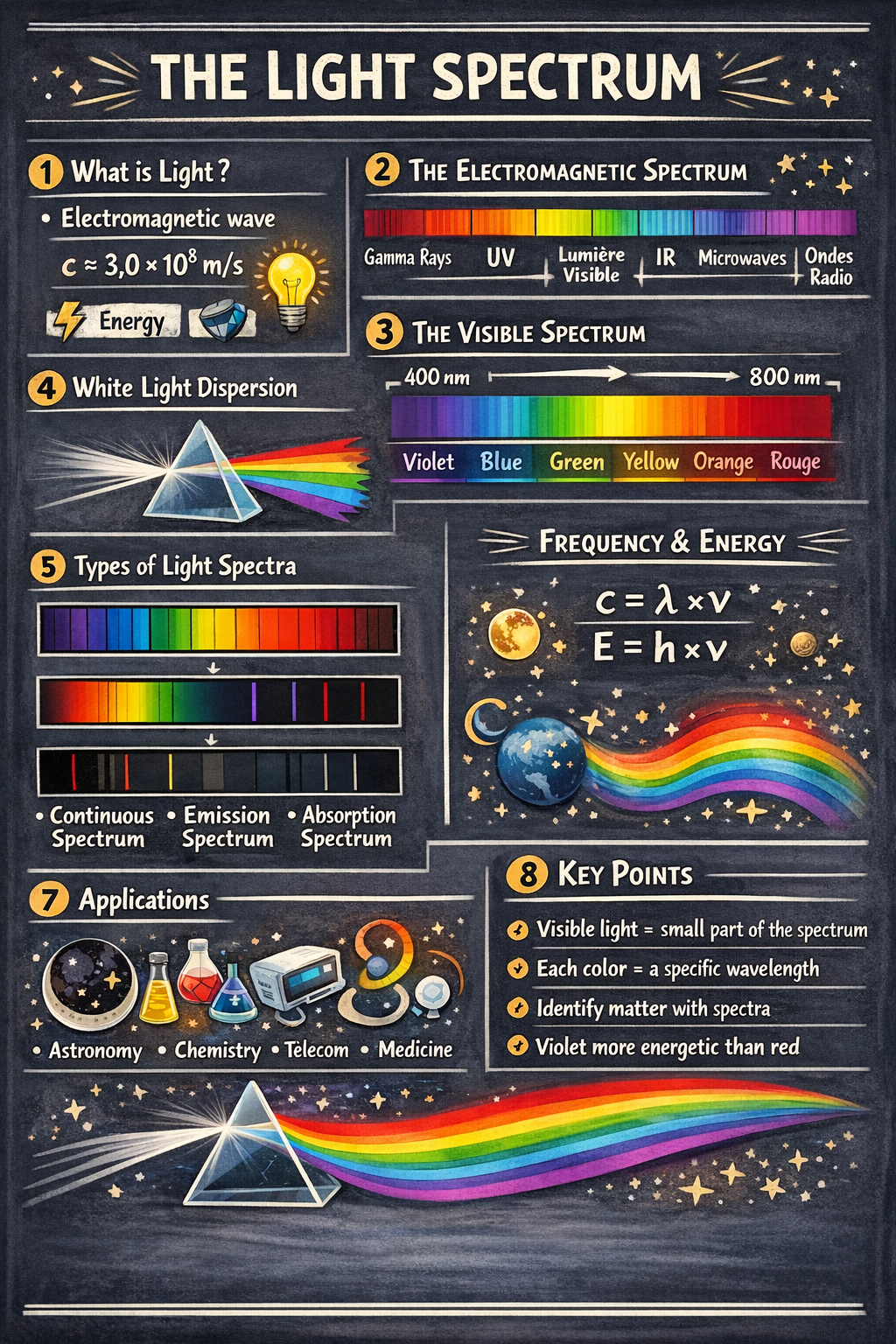
This infographic explains the light spectrum, covering electromagnetic waves, visible light, light dispersion, types of spectra, and their applications in various fields like astronomy and medicine.
Understanding the light spectrum is crucial for several reasons:
- Physics and Optics: Learning about the light spectrum enhances your understanding of fundamental physics concepts, such as electromagnetic waves and energy. This knowledge is essential for anyone interested in science and technology.
- Scientific Applications: The light spectrum has practical applications in various fields, including astronomy, chemistry, telecommunications, and medicine. For instance, astronomers use spectra to identify the composition of stars, while chemists analyze substances through spectroscopy.
- Technological Advancements: Many modern technologies, such as fiber optics and medical imaging, rely on principles of light and spectra. Understanding these concepts can lead to innovations and improvements in these technologies.
- Critical Thinking: Studying the light spectrum encourages analytical thinking and problem-solving skills. It involves understanding complex concepts and applying them to real-world situations.
- Interdisciplinary Connections: The light spectrum connects various scientific disciplines, offering a comprehensive view of how different fields interact and contribute to technological progress.
In summary, mastering the light spectrum not only enriches your scientific knowledge but also equips you with skills and insights applicable to numerous professional and academic pursuits.
You may be interested in these quizzes
Understanding the Light Spectrum
Physics
Optics
Science
10/02/2026
This infographic explains the light spectrum, covering electromagnetic waves, visible light, light dispersion, types of spectra, and their applications in various fields like astronomy and medicine.
Number of questions : 8
Fundamental Concepts of Physics
Physics
Science
Education
01/03/2026
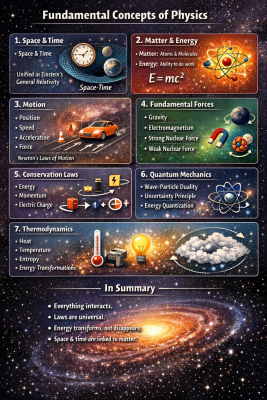
This infographic outlines the fundamental concepts of physics, including space-time, matter and energy, motion, fundamental forces, conservation laws, quantum mechanics, and thermodynamics. It summarizes key principles such as the interaction of everything, universal laws, energy transformation, and the link between space, time, and matter.
Number of questions : 8
Thermal Equilibrium and Heat Transfer
Physics
Thermodynamics
Science
26/02/2026
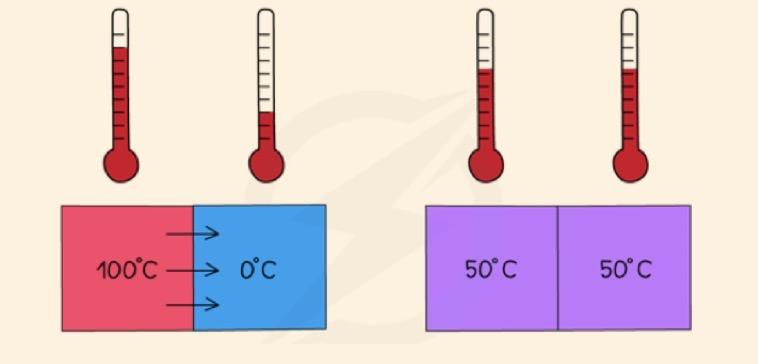
The image illustrates the concept of thermal equilibrium and heat transfer between two objects at different temperatures until they reach the same temperature.
Number of questions : 8
Special Relativity Overview
Physics
Science
Relativity
26/01/2026
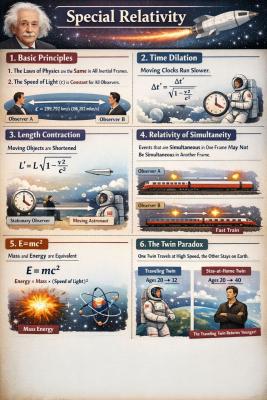
This document provides an overview of Einstein's theory of special relativity, covering basic principles, time dilation, length contraction, relativity of simultaneity, mass-energy equivalence, and the twin paradox.
Number of questions : 8
Magnetic and Non-Magnetic Substances
Physics
Education
Science
19/01/2026
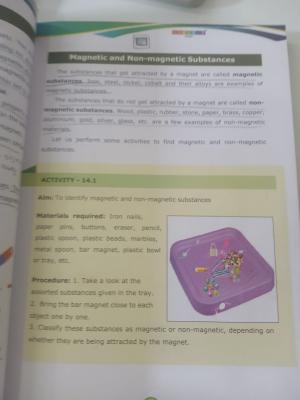
The document explains the difference between magnetic and non-magnetic substances. It provides examples of each type and includes an activity to identify these substances using a bar magnet. Materials needed for the activity are listed, and a procedure is outlined for classifying objects based on their magnetic properties.
Number of questions : 8
Magnet and Its Types
Physics
History
Science
19/01/2026
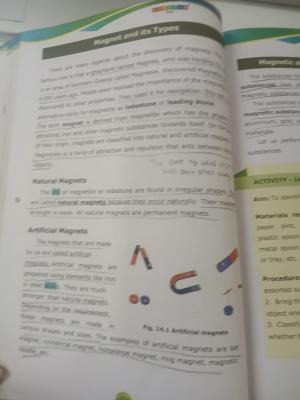
The document explains the discovery and types of magnets, including natural and artificial magnets. It discusses the historical significance of magnets, their uses, and the differences between natural and artificial magnets. The document also provides examples of artificial magnets and their applications.
Number of questions : 8
Introduction to General Relativity
Physics
Astronomy
Science
04/01/2026
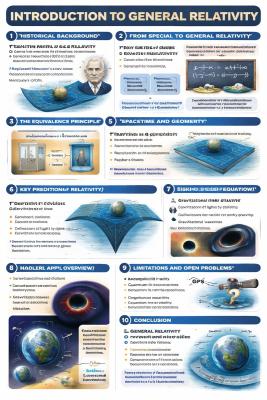
This infographic provides an overview of general relativity, covering its historical background, transition from special to general relativity, key principles like the equivalence principle, and applications. It also discusses predictions, limitations, and open problems in the field.
Number of questions : 8