
Quiz - Chemistry Exam: Key Concepts
Question 3 / 8
Which gas law relates pressure and volume inversely?
You may be interested in these quizzes
Chemistry Exam: Key Concepts
Chemistry
Physics
Science Education
06/01/2026
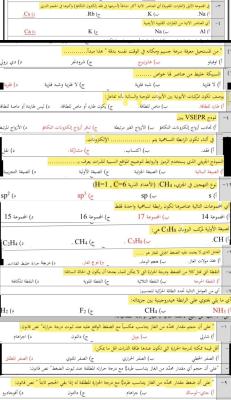
This document is a chemistry exam covering topics such as atomic structure, chemical bonding, molecular geometry, and gas laws. It includes multiple-choice questions that test knowledge of periodic table elements, VSEPR theory, hybridization, and thermodynamic principles.
Number of questions : 8
Understanding Isotopes and Mass
Chemistry
Physics
Atomic Structure
28/10/2026
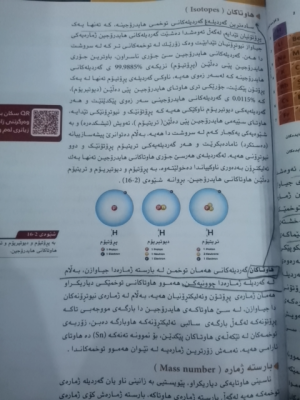
This document explains isotopes, focusing on hydrogen isotopes and their properties. It discusses atomic structure, isotopic abundance, and mass number, providing visual diagrams for better understanding.
Number of questions : 8
Introduction to Static Electricity
Physics
Electricity
Science Education
24/10/2026
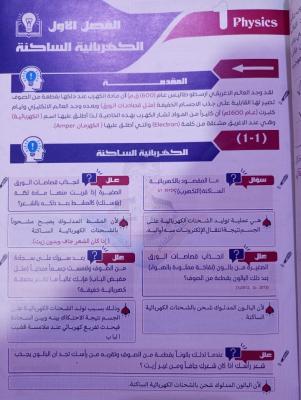
This document is an introductory page from a physics textbook, focusing on static electricity. It explains the concept of static charges, their historical discovery, and basic principles. The page includes questions and true/false statements to test understanding.
Number of questions : 8
Introduction to Static Electricity
Physics
Electricity
Science Education
24/10/2026
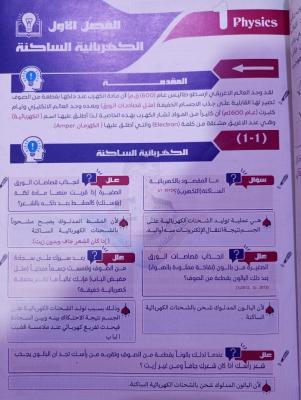
This document is an introduction to static electricity, explaining the concept, historical discoveries, and basic principles. It includes questions and answers to test understanding of static electricity phenomena, such as electron transfer and charge generation.
Number of questions : 8
History and Development of Atomic Theory
Chemistry
History of Science
Physics
23/08/2026
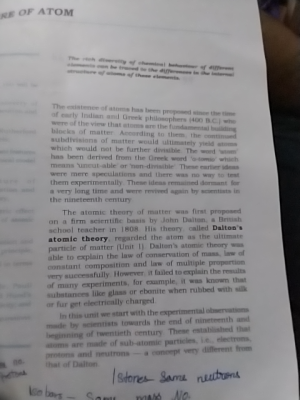
This document discusses the historical development of atomic theory, starting from early philosophical ideas to John Dalton's scientific proposal in 1808. It highlights the evolution of the concept of atoms as indivisible particles and the challenges faced in experimental validation.
Number of questions : 8
Radioactivity: Invisible and Ionizing
Physics
Chemistry
Health
04/03/2026
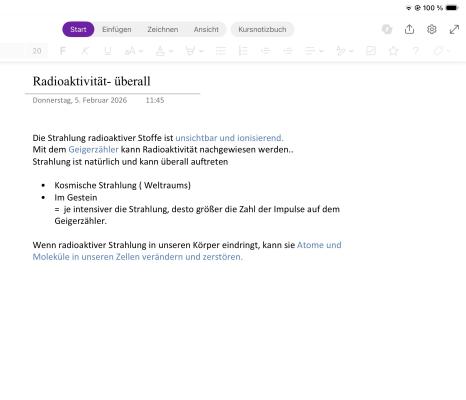
The document explains the nature of radioactive radiation, its invisibility, and ionizing properties. It discusses how radiation can be detected using a Geiger counter and its natural occurrence in cosmic rays and rocks. It also highlights the potential damage to atoms and molecules in cells.
Number of questions : 8
Understanding Molecules and Bonds
Chemistry
Science Education
Molecular Structure
14/02/2026
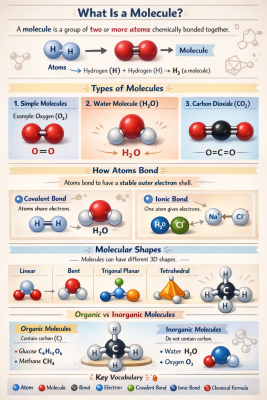
This infographic explains what a molecule is, types of molecules, how atoms bond, molecular shapes, and the difference between organic and inorganic molecules. It covers basic concepts such as covalent and ionic bonds, and provides examples like water, oxygen, and carbon dioxide.
Number of questions : 8