
Quiz - Understanding Molecules and Bonds
Number of questions :
8
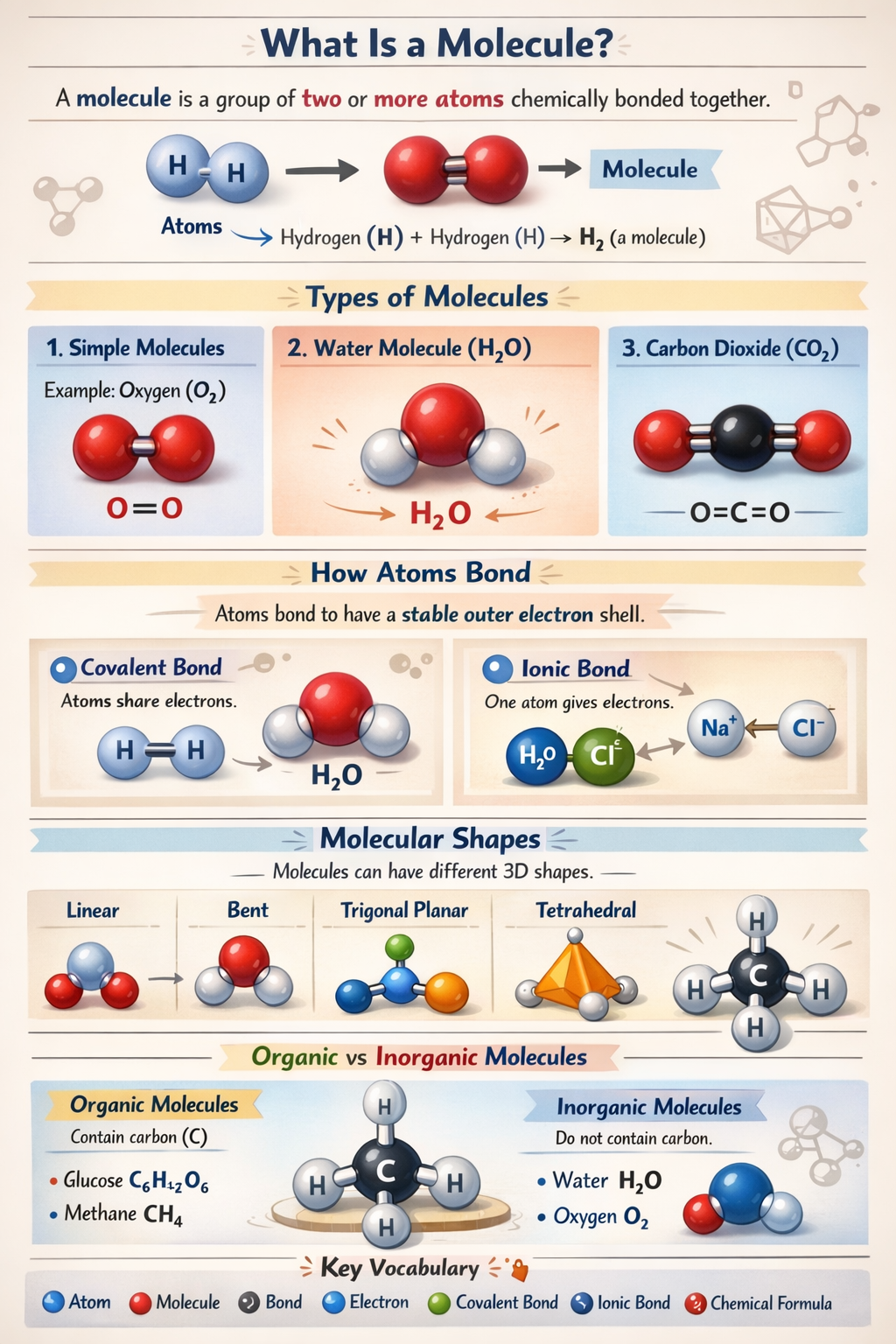
This infographic explains what a molecule is, types of molecules, how atoms bond, molecular shapes, and the difference between organic and inorganic molecules. It covers basic concepts such as covalent and ionic bonds, and provides examples like water, oxygen, and carbon dioxide.
Understanding molecules and their bonds is fundamental to chemistry and science.
- By learning about molecules, you gain insight into the basic building blocks of matter. This knowledge is crucial for fields like biology, physics, and environmental science. Understanding how atoms bond to form molecules helps explain the properties and behaviors of different substances.
- Covalent and ionic bonds are essential concepts that explain how atoms interact. Covalent bonds involve sharing electrons, while ionic bonds involve transferring electrons. These interactions determine the stability and reactivity of molecules.
- Molecular shapes influence how molecules interact with each other. For example, the bent shape of water molecules leads to its unique properties, such as surface tension and solvent abilities.
- Organic vs. inorganic molecules: Knowing the difference helps in understanding biological processes and the composition of various materials. Organic molecules contain carbon and are vital for life, while inorganic molecules are found in non-living systems.
- This quiz enhances your comprehension of these concepts, making you more informed about the natural world and better prepared for advanced studies in science. It fosters critical thinking and problem-solving skills, which are valuable in both academic and real-world scenarios.
You may be interested in these quizzes
Understanding Molecules and Bonds
Chemistry
Science Education
Molecular Structure
14/02/2026
This infographic explains what a molecule is, types of molecules, how atoms bond, molecular shapes, and the difference between organic and inorganic molecules. It covers basic concepts such as covalent and ionic bonds, and provides examples like water, oxygen, and carbon dioxide.
Number of questions : 8
Chemistry Exam: Key Concepts
Chemistry
Physics
Science Education
06/01/2026
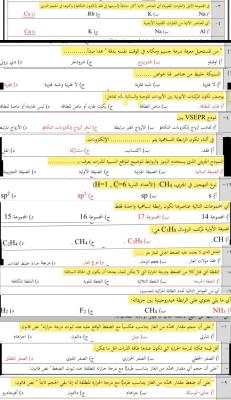
This document is a chemistry exam covering topics such as atomic structure, chemical bonding, molecular geometry, and gas laws. It includes multiple-choice questions that test knowledge of periodic table elements, VSEPR theory, hybridization, and thermodynamic principles.
Number of questions : 8
Chemical Reactions Educational Poster
Chemistry
Science Education
Laboratory Safety
05/01/2026
This document is an educational poster about chemical reactions, covering topics such as reactants and products, signs and types of chemical reactions, conservation of mass, chemical equations, and safety rules in the lab.
Number of questions : 8
Classification of Elements and Periodicity
Chemistry
Periodic Table
Atomic Structure
23/08/2026
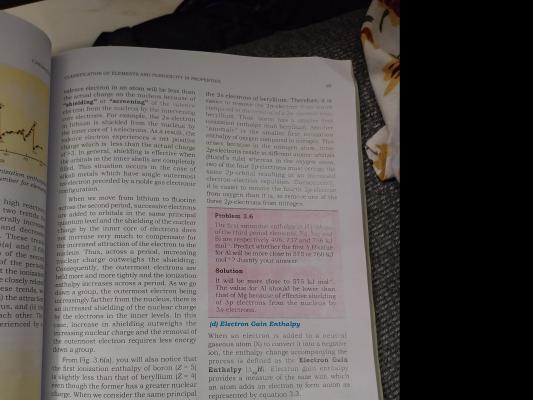
This document explains the classification of elements and periodicity in properties, focusing on concepts like shielding, ionization enthalpy, and electron gain enthalpy. It discusses how these properties vary across periods and groups in the periodic table, using examples like lithium, beryllium, and boron.
Number of questions : 8
Atomic Radii and Periodic Trends
Chemistry
Periodic Table
Atomic Structure
23/08/2026
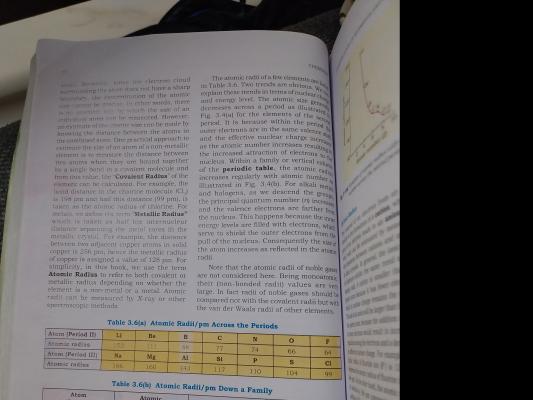
This document explains the concept of atomic radii, including covalent and metallic radii, and how they vary across periods and down groups in the periodic table. It includes tables showing atomic radii for various elements, illustrating trends and providing a basis for understanding atomic size variations.
Number of questions : 8
Mendeleev's Periodic Table Development
Chemistry
History of Science
Periodic Table
23/08/2026
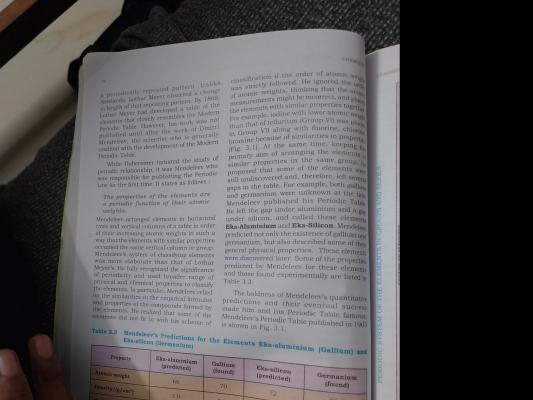
This document discusses the development of the periodic table, focusing on Mendeleev's contributions. It highlights the periodicity of elements based on atomic weights and Mendeleev's predictions for undiscovered elements like eka-aluminium and eka-silicon, which were later identified as gallium and germanium.
Number of questions : 8
History of Periodic Classification
Chemistry
History of Science
Periodic Table
23/08/2026
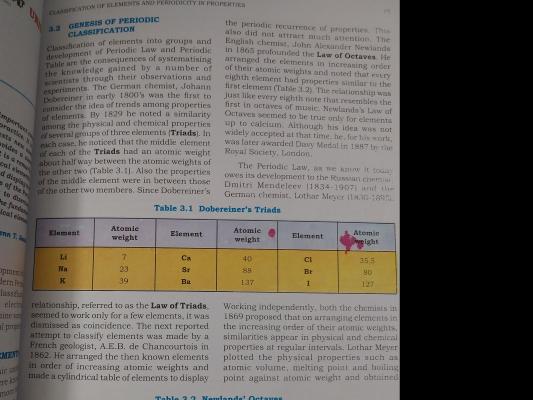
This document discusses the historical development of the periodic classification of elements, focusing on the contributions of scientists like Johann Döbereiner and John Newlands. It explains the concepts of Triads and the Law of Octaves, which were early attempts to organize elements based on their properties.
Number of questions : 8