
Quiz - Thales' Theorem Geometry Lesson
Question 1 / 8
What is Thales' Theorem primarily used for?
You may be interested in these quizzes
Thales' Theorem Geometry Lesson
Geometry
Mathematics
Proportionality
08/01/2026
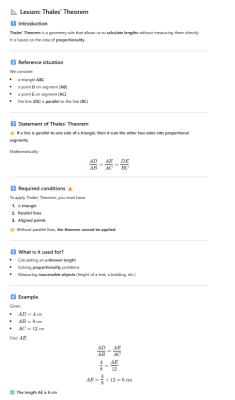
This document explains Thales' Theorem, a geometry rule used to calculate lengths without direct measurement, based on proportionality. It includes the theorem's statement, required conditions, and practical applications, such as solving proportionality problems and measuring inaccessible objects. An example problem is provided to illustrate its use.
Number of questions : 8
Circle and Cone Geometry Basics
Geometry
Mathematics
Education
05/02/2026
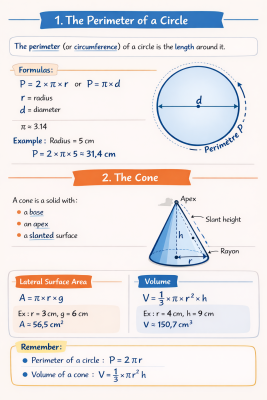
This document explains the formulas for calculating the perimeter of a circle and the properties of a cone, including its lateral surface area and volume. It provides examples and key formulas for understanding these geometric concepts.
Number of questions : 8
Mathematics Lesson on Hyperbolas
Mathematics
Geometry
Algebra
28/02/2026
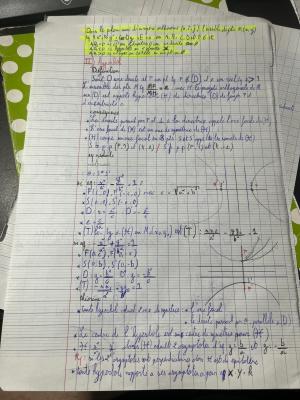
This document is a mathematics lesson on hyperbolas, covering definitions, properties, and equations. It includes diagrams and examples to illustrate the concepts, focusing on the geometric and algebraic aspects of hyperbolas in a Cartesian plane.
Number of questions : 8
Circle Geometry Lesson Overview
Geometry
Mathematics
Education
27/01/2026
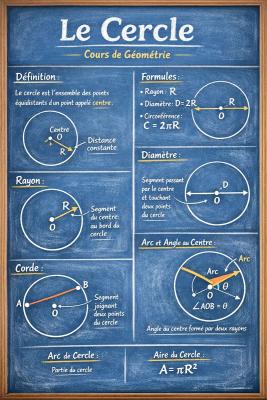
This document is a geometry lesson about circles, covering definitions, formulas, and properties such as radius, diameter, chord, arc, and central angle.
Number of questions : 8
Protractor Angle Measurement Exercise
Mathematics
Geometry
Measurement
20/01/2026
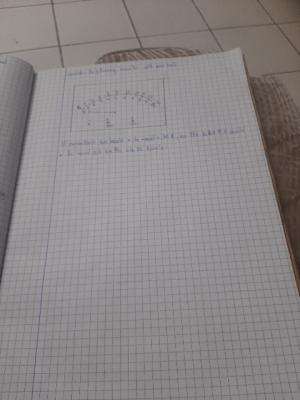
The document is a math exercise involving a protractor and angle measurement. It includes a diagram of a protractor and a task to determine the angle based on given conditions.
Number of questions : 8
Geometry: Parallel Lines and Angles
Geometry
Mathematics
Education
12/01/2026
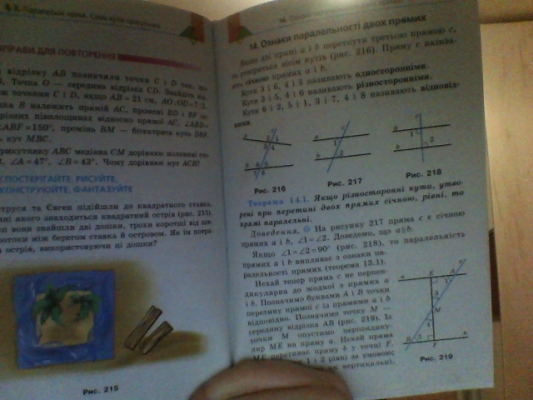
This document is a geometry textbook page discussing the properties of parallel lines and angles formed by a transversal. It includes diagrams and exercises to illustrate the concepts of corresponding, alternate, and interior angles, as well as the conditions for parallelism.
Number of questions : 8