
Quiz - Space Exploration Quiz Questions

Number of questions :
8
This document contains a series of questions related to space exploration, focusing on missions, astronauts, and space agencies. It covers historical milestones, recent achievements, and specific details about space programs from various countries.
Learning about space exploration is crucial for several reasons:
- Understanding Human Achievement: Space exploration represents one of humanity's greatest achievements. By studying it, you gain insight into the technological and scientific advancements that have shaped our modern world.
- Inspiration and Innovation: The challenges of space travel have led to numerous innovations that impact our daily lives, from satellite communications to medical technologies.
- Global Collaboration: Space missions often involve international cooperation, highlighting the importance of working together across borders to achieve common goals.
- Scientific Knowledge: Exploring space helps us understand fundamental questions about the universe, such as the origins of stars and planets, and the potential for life beyond Earth.
- Future Opportunities: As space exploration continues to evolve, it opens up new opportunities for careers in science, engineering, and technology.
By engaging with this quiz, you not only test your knowledge but also deepen your appreciation for the complexities and wonders of space exploration. This understanding is essential for anyone interested in science, technology, or the future of human civilization.
You may be interested in these quizzes
Space Exploration Quiz Questions

Space Exploration
Astronomy
Science
30/08/2026
This document contains a series of questions related to space exploration, focusing on missions, astronauts, and space agencies. It covers historical milestones, recent achievements, and specific details about space programs from various countries.
Number of questions : 8
Introduction to General Relativity
Physics
Astronomy
Science
04/01/2026
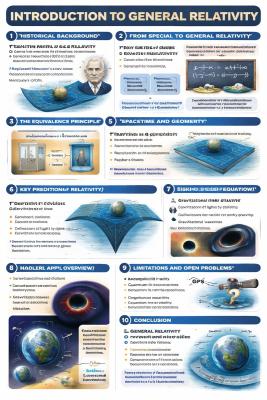
This infographic provides an overview of general relativity, covering its historical background, transition from special to general relativity, key principles like the equivalence principle, and applications. It also discusses predictions, limitations, and open problems in the field.
Number of questions : 8
Periodic Table of Elements Overview
Chemistry
Science
Education
24/02/2026
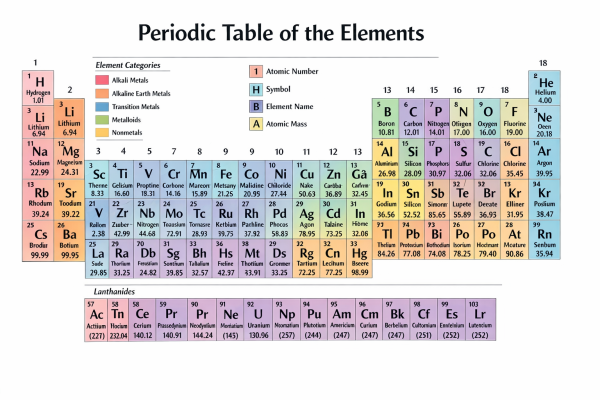
The periodic table organizes chemical elements by increasing atomic number, grouping them into categories such as alkali metals, transition metals, and nonmetals. It provides essential information like atomic mass and element symbols, serving as a fundamental tool in chemistry for understanding element properties and relationships.
Number of questions : 8
Elements and Periodic Table Overview
Chemistry
Education
Science
30/01/2026
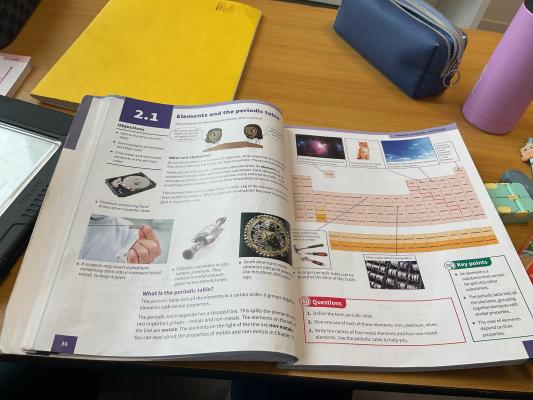
This document is an educational page about the periodic table and elements. It explains the definition of elements, the importance of platinum, and the structure of the periodic table. It also includes examples of metals and non-metals and their uses in everyday life.
Number of questions : 8
Fundamental Concepts of Physics
Physics
Science
Education
01/03/2026
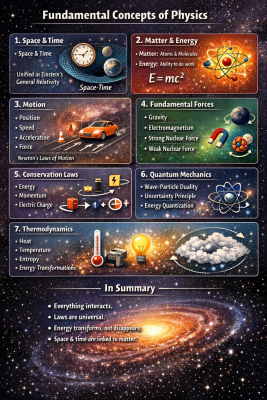
This infographic outlines the fundamental concepts of physics, including space-time, matter and energy, motion, fundamental forces, conservation laws, quantum mechanics, and thermodynamics. It summarizes key principles such as the interaction of everything, universal laws, energy transformation, and the link between space, time, and matter.
Number of questions : 8
Basic Chemistry Concepts Quiz
Science
Chemistry
Education
05/05/2026
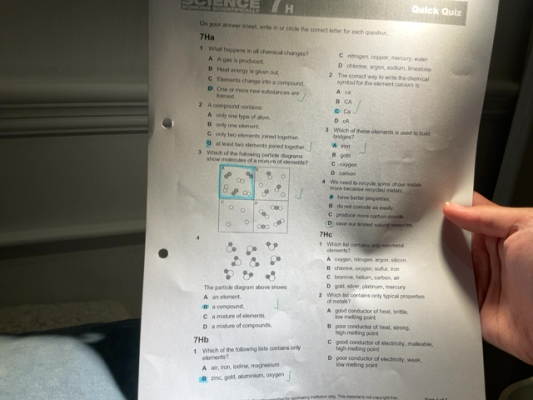
This document is a science quiz focused on basic chemistry concepts, including chemical changes, elements, compounds, and mixtures. It tests knowledge on particle diagrams, properties of metals, and the periodic table. The quiz is designed for students to assess their understanding of fundamental chemistry principles.
Number of questions : 8
Big Bang Theory Overview
Cosmology
Astronomy
Physics
08/07/2026
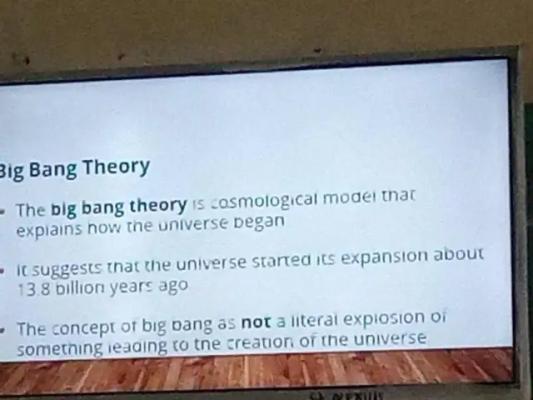
This document explains the Big Bang Theory, a cosmological model describing the universe's origin. It suggests the universe began expanding 13.8 billion years ago and clarifies that the Big Bang is not a literal explosion but a process leading to the universe's creation.
Number of questions : 8