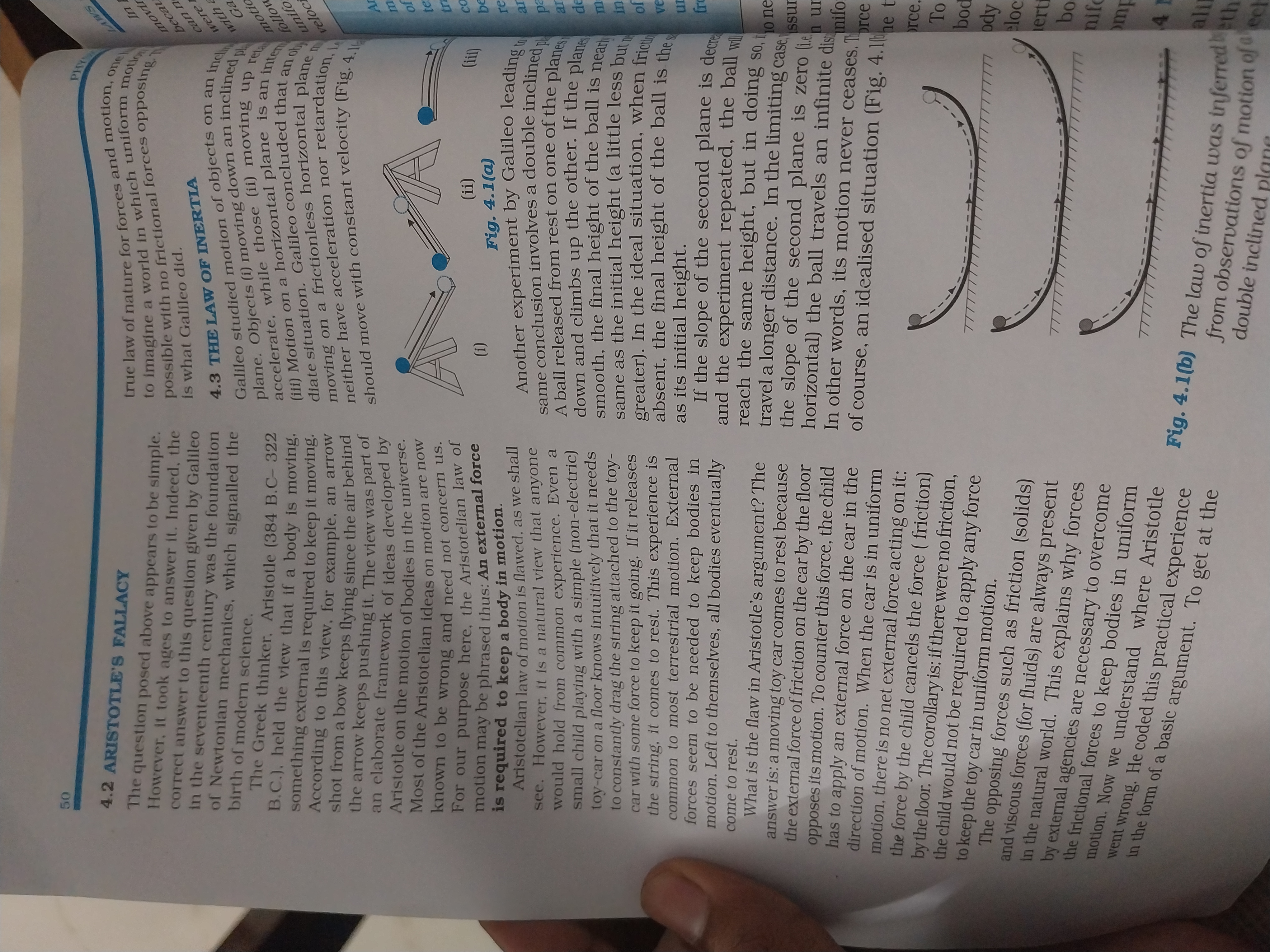
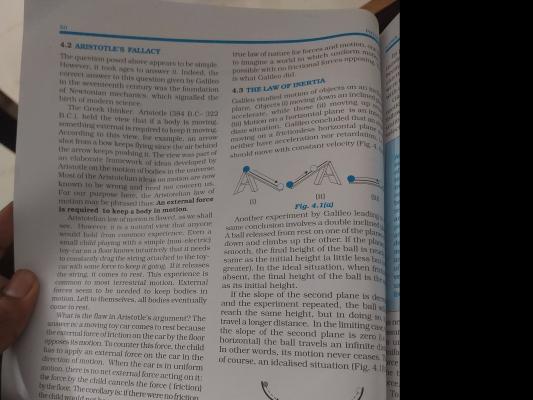
This document discusses Aristotle's fallacy regarding motion and the development of the law of inertia by Galileo. It explains how external forces like friction affect motion and how Galileo's experiments led to a better understanding of uniform motion.
Understanding Aristotle's Fallacy and Galileo's Law of Inertia
Learning Outcomes:
- Historical Insight: Gain an understanding of how scientific thought evolved from Aristotle's incorrect assumptions to Galileo's revolutionary ideas. - Physics Fundamentals: Learn about the basic principles of motion, including the role of external forces like friction and the concept of inertia. - Critical Thinking: Develop the ability to question established ideas and understand the importance of empirical evidence in shaping scientific theories.
Relevance:
Understanding these concepts is crucial for anyone interested in physics or the history of science. Aristotle's fallacy highlights the importance of questioning and testing ideas, a fundamental aspect of scientific inquiry. Galileo's work laid the groundwork for Newtonian physics, which is essential for understanding the physical world. By learning about these topics, you gain insight into the scientific method and the evolution of scientific thought. This knowledge is not only academically enriching but also enhances your ability to think critically and analytically in everyday life. Whether you're a student, educator, or simply curious about the world, this quiz offers valuable insights into the principles that govern motion and the historical context that shaped modern science.