
Quiz - Compound Ions and Valency Table
Number of questions :
8
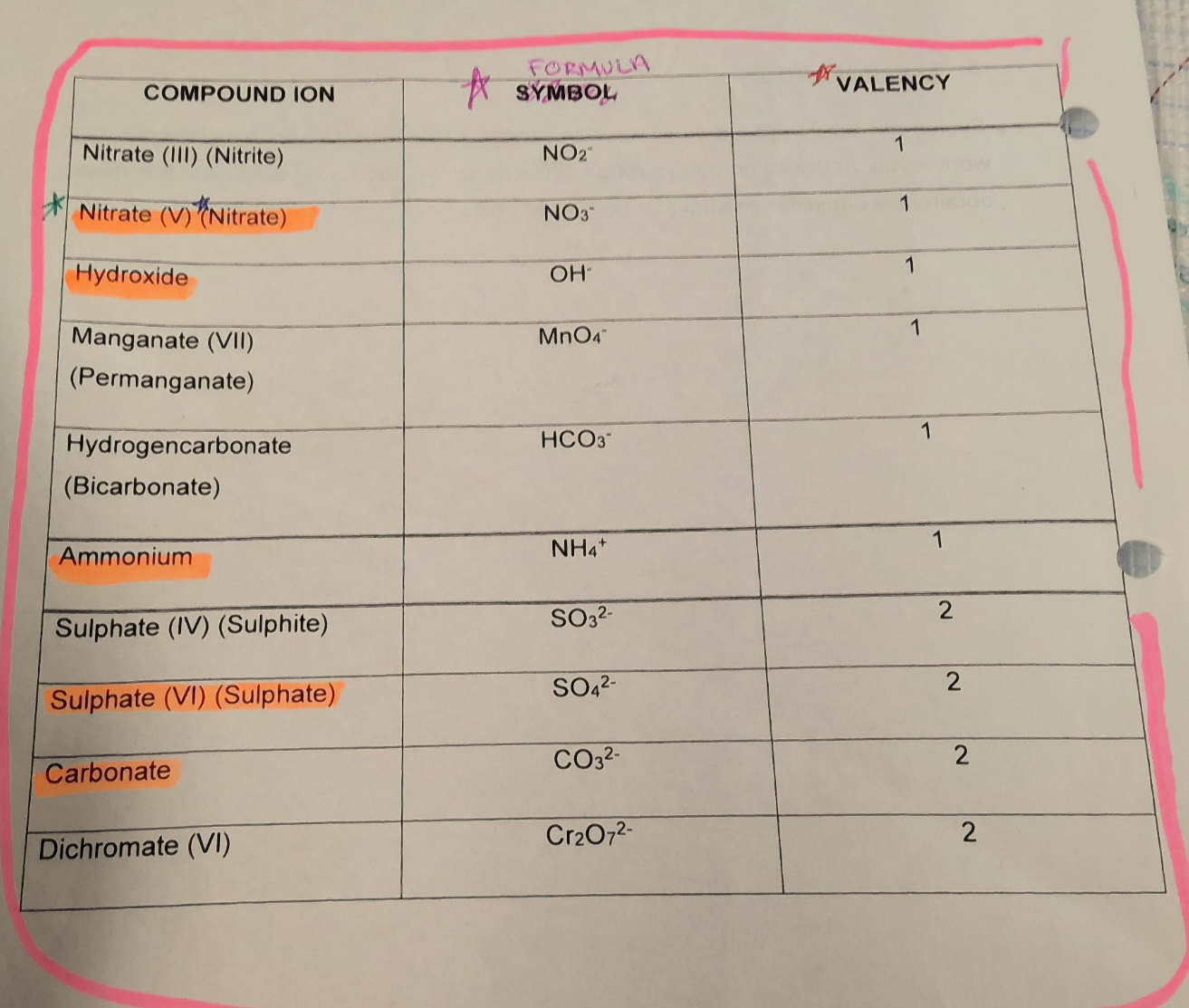
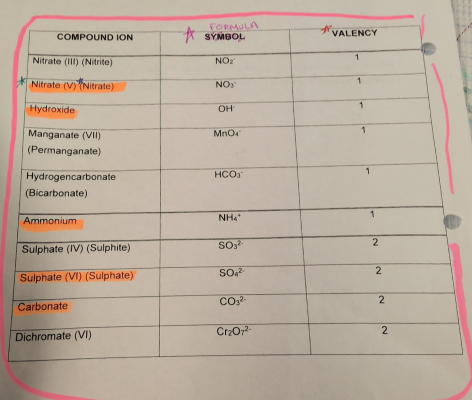
This document is a table listing various compound ions, their chemical symbols, and their valencies. It includes ions like nitrate, hydroxide, and ammonium, providing a quick reference for chemistry students to understand the composition and charge of these ions.
Understanding compound ions and their valencies is crucial for anyone studying chemistry.
- Chemical Reactions: Knowing the valency of ions helps predict how they will combine in chemical reactions, which is fundamental for creating new compounds.
- Balancing Equations: Mastery of ion charges is essential for balancing chemical equations, a key skill in both academic and professional chemistry.
- Real-World Applications: This knowledge is applicable in various fields such as pharmaceuticals, environmental science, and materials engineering, where chemical reactions are pivotal.
- Problem-Solving Skills: Engaging with this quiz enhances analytical skills, as it requires understanding and applying concepts rather than rote memorization.
- Foundation for Advanced Studies: A solid grasp of basic chemistry concepts like these ions and their valencies is foundational for more advanced studies in chemistry and related sciences.
By completing this quiz, you will not only reinforce your understanding of basic chemistry concepts but also develop skills that are widely applicable in scientific research and industry. This foundational knowledge is a stepping stone to more complex topics and innovations in science.
You may be interested in these quizzes
Periodic Table of Elements Overview
Chemistry
Science
Education
24/02/2026
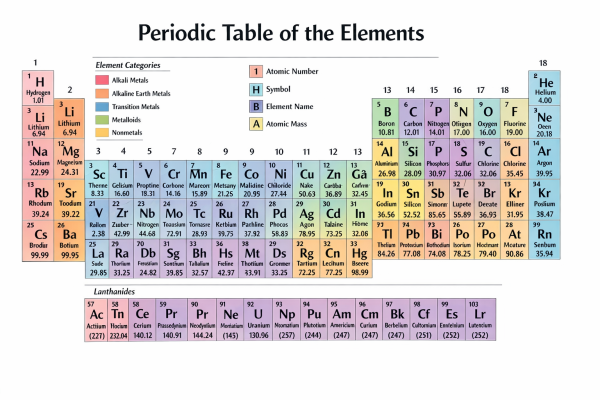
The periodic table organizes chemical elements by increasing atomic number, grouping them into categories such as alkali metals, transition metals, and nonmetals. It provides essential information like atomic mass and element symbols, serving as a fundamental tool in chemistry for understanding element properties and relationships.
Number of questions : 8
Elements and Periodic Table Overview
Chemistry
Education
Science
30/01/2026
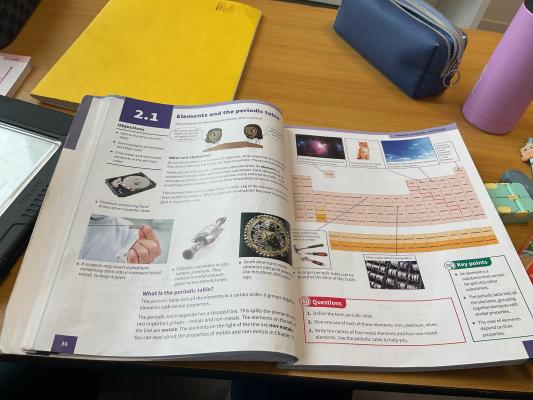
This document is an educational page about the periodic table and elements. It explains the definition of elements, the importance of platinum, and the structure of the periodic table. It also includes examples of metals and non-metals and their uses in everyday life.
Number of questions : 8
Basic Chemistry Concepts Quiz
Science
Chemistry
Education
05/05/2026
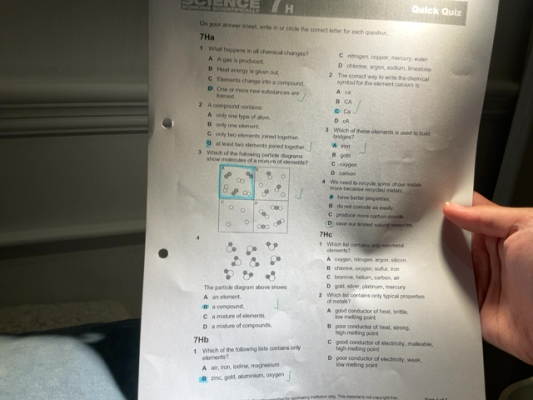
This document is a science quiz focused on basic chemistry concepts, including chemical changes, elements, compounds, and mixtures. It tests knowledge on particle diagrams, properties of metals, and the periodic table. The quiz is designed for students to assess their understanding of fundamental chemistry principles.
Number of questions : 8
Compound Ions and Valency Table
Chemistry
Education
Science
13/10/2026
This document is a table listing various compound ions, their chemical symbols, and their valencies. It includes ions like nitrate, hydroxide, and ammonium, providing a quick reference for chemistry students to understand the composition and charge of these ions.
Number of questions : 8
Chemical Kinetics Overview
Chemistry
Science
Education
27/02/2026
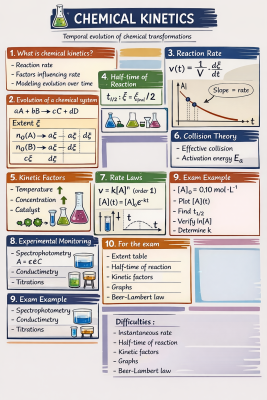
This document provides an overview of chemical kinetics, covering reaction rates, factors influencing these rates, and methods for monitoring chemical reactions. It includes key concepts such as collision theory, rate laws, and experimental techniques like spectrophotometry and conductimetry.
Number of questions : 8
Types of Chemical Reactions
Chemistry
Education
Science
08/12/2025
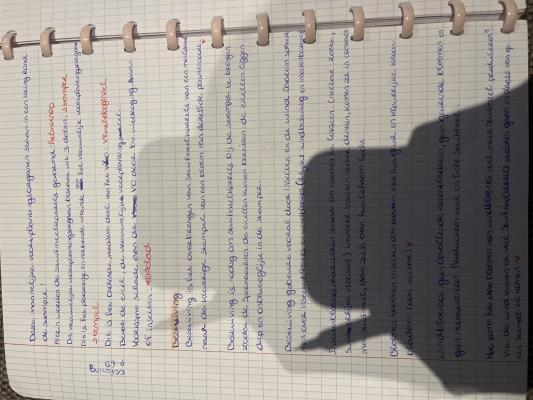
This document is a handwritten page of notes discussing various types of chemical reactions, including synthesis, decomposition, and combustion. It explains the characteristics and examples of each reaction type, providing a foundational understanding of basic chemistry concepts.
Number of questions : 8
Fundamental Concepts of Physics
Physics
Science
Education
01/03/2026
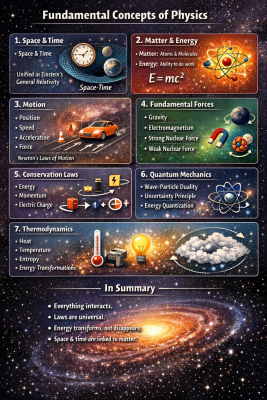
This infographic outlines the fundamental concepts of physics, including space-time, matter and energy, motion, fundamental forces, conservation laws, quantum mechanics, and thermodynamics. It summarizes key principles such as the interaction of everything, universal laws, energy transformation, and the link between space, time, and matter.
Number of questions : 8