
Quiz - Microcontroller Programming with MakeCode
Number of questions :
8
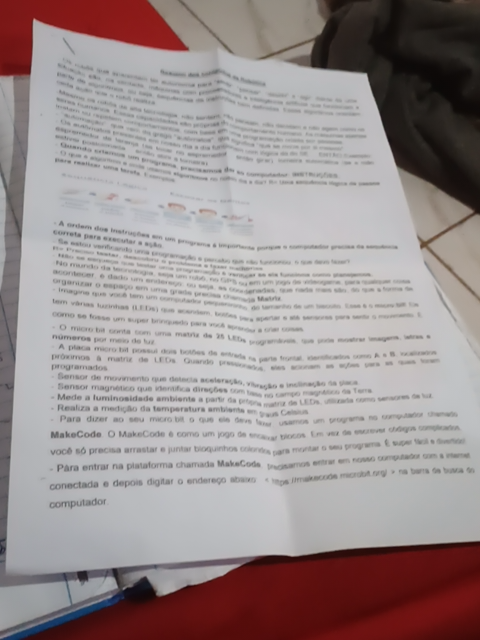
The document is an educational guide on using microcontrollers and programming with MakeCode. It explains how to connect and program a microcontroller to perform tasks like measuring light and temperature. It also provides instructions on accessing the MakeCode platform online.
Learning about microcontroller programming with MakeCode offers several benefits:
- Technological Proficiency: Understanding how to program microcontrollers enhances your technical skills, which are increasingly valuable in today's digital world.
- Problem-Solving Skills: Programming requires logical thinking and problem-solving, skills that are applicable in many areas of life and work.
- Innovation and Creativity: By learning to program, you can create innovative solutions and projects, fostering creativity and innovation.
- Career Opportunities: Knowledge in programming and technology opens up numerous career paths in fields such as engineering, IT, and software development.
- Educational Growth: Engaging with educational platforms like MakeCode can enhance learning experiences and provide a foundation for further study in technology and computer science.
Overall, this quiz helps solidify your understanding of microcontroller programming, making you more adept in technology and better prepared for future technological advancements.
You may be interested in these quizzes
Microcontroller Programming with MakeCode

Technology
Programming
Education
18/10/2026
The document is an educational guide on using microcontrollers and programming with MakeCode. It explains how to connect and program a microcontroller to perform tasks like measuring light and temperature. It also provides instructions on accessing the MakeCode platform online.
Number of questions : 8
Printing Handouts Options Quiz
Technology
Education
Printing
26/09/2026
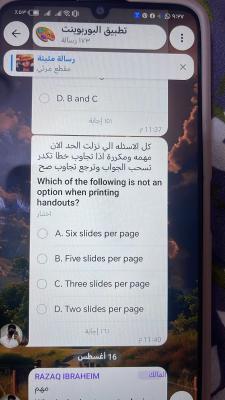
The document is a screenshot of a messaging app showing a multiple-choice question about printing handouts, with options for the number of slides per page.
Number of questions : 8
Periodic Table of Elements Overview
Chemistry
Science
Education
24/02/2026
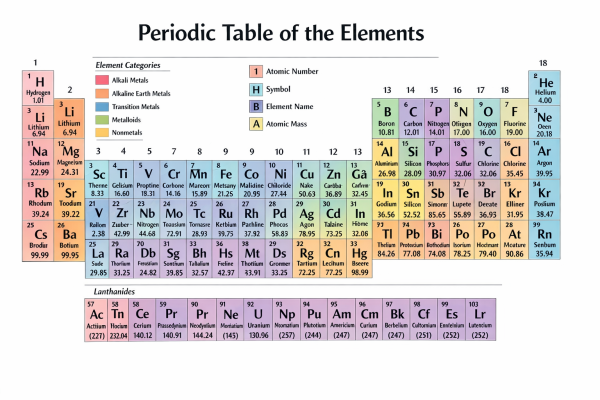
The periodic table organizes chemical elements by increasing atomic number, grouping them into categories such as alkali metals, transition metals, and nonmetals. It provides essential information like atomic mass and element symbols, serving as a fundamental tool in chemistry for understanding element properties and relationships.
Number of questions : 8
Countries and Capitals List

Geography
Education
World Knowledge
20/02/2026
A list of countries and their capitals, written in two columns on a sheet of paper. The document appears to be a study guide for learning the capitals of various countries.
Number of questions : 8
Elements and Periodic Table Overview
Chemistry
Education
Science
30/01/2026
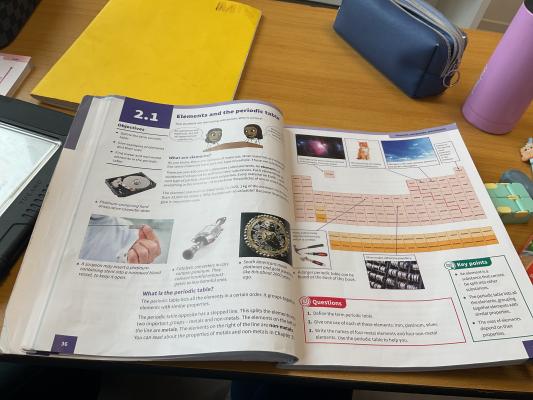
This document is an educational page about the periodic table and elements. It explains the definition of elements, the importance of platinum, and the structure of the periodic table. It also includes examples of metals and non-metals and their uses in everyday life.
Number of questions : 8
Circle and Cone Geometry Basics
Geometry
Mathematics
Education
05/02/2026
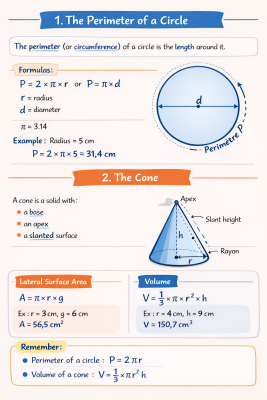
This document explains the formulas for calculating the perimeter of a circle and the properties of a cone, including its lateral surface area and volume. It provides examples and key formulas for understanding these geometric concepts.
Number of questions : 8
Fundamental Concepts of Physics
Physics
Science
Education
01/03/2026
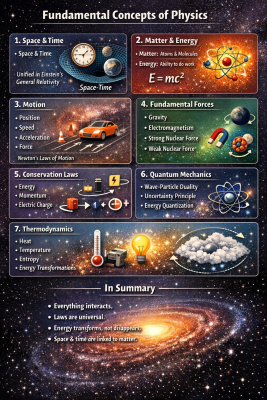
This infographic outlines the fundamental concepts of physics, including space-time, matter and energy, motion, fundamental forces, conservation laws, quantum mechanics, and thermodynamics. It summarizes key principles such as the interaction of everything, universal laws, energy transformation, and the link between space, time, and matter.
Number of questions : 8